Kenzo Yamaguchi, Colin Powers, and Ahmed Al Fardan,
As college students, technology is integral to our lives and studies. We use ChatGPT to understand assignments, Google Maps to get around, and our phones to remind us of things we’d probably forget. We can’t imagine going through a normal day without these tools. But recently, we have started wondering if relying on technology so much is affecting how much we think for ourselves.
For example, when we use ChatGPT to help with assignments, we sometimes get the answer without fully understanding how to arrive at it ourselves. It makes us question whether technology is helping us become better thinkers or making us dependent on it.
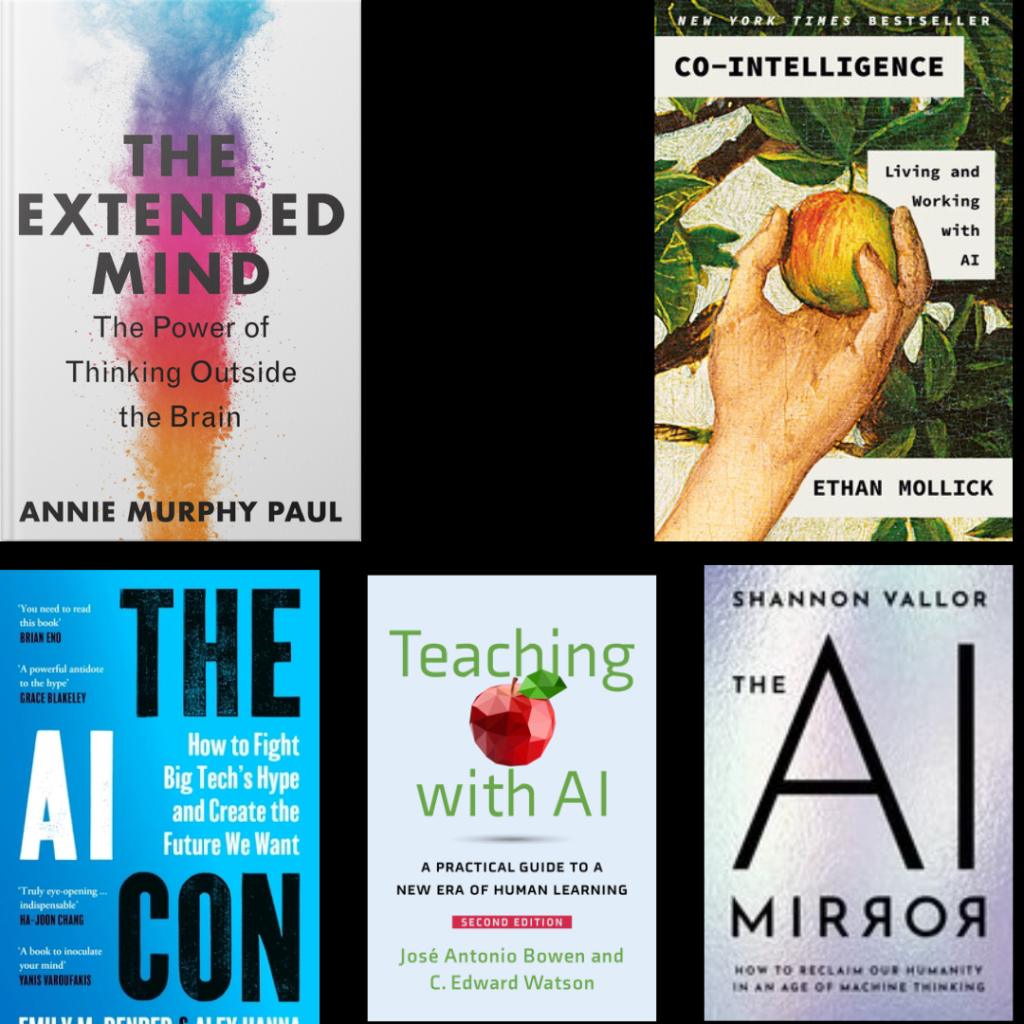
That question interested us, so we decided to research five books that explore the relationship between technology and human thinking. What we discovered made us question how much of our thinking we should let machines do for us.
The first book that caught our attention was The Extended Mind: The Power of Thinking Outside the Brain (2021) by Annie Murphy Paul. She explores how our thinking depends on more than just our brains, including our surroundings and interactions with others.
That idea connects to Co-Intelligence: Living and Working with AI (2024) by Ethan Mollick. He explores how AI can work alongside humans as a teacher and collaborator. We find this relatable because we use ChatGPT to study and understand different subjects. Sometimes it helps us understand a problem, but other times we’re tempted to accept its answer without working through the steps ourselves. There’s a big difference between understanding something and just getting the correct answer.
This question about education led us to Teaching with AI: A Practical Guide to a New Era of Human Learning (2024) by José Antonio Bowen and C. Edward Watson. They explore how education should adapt to generative AI. If a student submits an excellent essay written by AI, does the grade reflect the student’s understanding or the machine’s abilities?
We found The AI Con: How to Fight Big Tech’s Hype and Create the Future We Want (2025) by Emily M. Bender and Alex Hanna. The authors challenge exaggerated claims about AI and question how technology companies present their products. This reminded us that AI can sound confident even when its answers are wrong, making it important to question what we’re told.
Another book that interested us was The AI Mirror: How to Reclaim Our Humanity in an Age of Machine Thinking (2024) by Shannon Vallor. She questions how AI affects the way we understand ourselves and the world. It made us wonder whether students who rely on ChatGPT to write essays might eventually start sounding alike, even when they have different opinions.
Researching these books made us realize that technology itself isn’t necessarily the problem. What matters is how we choose to use it. We don’t want to reach a point where we need ChatGPT to solve every problem we come across. Sometimes, figuring something out on our own is what actually helps us learn.

