Zander Lowery, Colleen Yang, Cengiz Ciner
In February, Open-AI’s GPT-4o was discontinued, causing massive backlash among those who used it. For those who advocated for the model to come back, a pattern was visible: they considered GPT- 4o more than simply another AI model, but rather perceived it as a friend, companion, or even as a family member. Companions are intuitively considered to be good, and indeed having social interactions with other users online have led to positive real-world consequences. But when that companionship is with an AI companion, such interactions are radically varied. When does it become too much?
This idea of having virtual companionships fascinated us because we grew up with the understanding that in-person human relationships were most important to our development, especially as children. As students researching the fields of Computer Science, Human Development and Family Studies, and Data Science, our group was keen on exploring AI technology and the sudden phenomenon of users adopting AI models as friends, family, and even intimate partners. It made us curious about what defines a healthy virtual connection compared to an unhealthy one. As reported in The New York Times in October 2026, China has been cracking down on over-usage, reliance on AI, and the boom of virtual companion apps due to negative repercussions of how and how much they are being used. Earlier in July, the Chinese government “imposed limits on A.I. companions that require platforms to step in if users exhibited unhealthy dependencies. Under the new rules, platforms must intervene if users show signs of self-harm.” This can be reviewed as an instance revealing A.I. companions as a real issue. But is it really as alarming as they are making it out to be?
This year, the American Psychological Association (APA) released an article on this subject, exploring the mental health risks and benefits of digital relationships in a world that is increasingly reliant on AI chatbots across people’s jobs and social lives. Character.AI, a generative AI chatbot service where users can interact with, as well as design unique chatbots, was cited to have 20 million users, most under the age of 24. The APA cites that most users are using generative AI tools for therapy and companionship and when people are under distress or experiencing a lack of human company, they are more likely to develop an attachment to the tools if they perceive them to be offering genuine emotional support. This is common when “AI chatbots and companions are increasingly configured to simulate empathy, offering users nonjudgmental responses and continual validation.”
A recent Stanford study reported that they surveyed 1,131 users of Character.AI, 244 of which donated entire transcripts of their chats. They found that heavy chatbot use among people with small offline social networks was linked to lower well-being, especially when companionship was the main reason for using the bot. Notably, those who shared sensitive personal information with the bot were also more likely to demonstrate a lower sense of well-being, which is opposite to what we typically expect when disclosure happens in human relationships.
But not all virtual companions are so blatantly bad. Namely, one of the most popular Gacha games (games that use randomized, gambling-like mechanics to let players win virtual in-game items) on the market is called Love and Deepspace (LADS). LADS is an Otome game, a narrative-based romance game that places the player as the primary subject in virtual character-based interactions. The game itself is designed with the goal of the player forming an emotional bond to one or more love interests through deep story telling, dialogue, and ongoing interactions. Players use Wishes to pull “Memories” that feature the game’s male love interests. Using these memories, the player will enter an interactive sequence with the love interest that lasts anywhere from a few minutes to about one to two hours.
Gacha mechanics aside, the premise is much the same– you have a virtual companion with whom you are forming an emotional attachment to. But users have vastly reported contradictory consequences from LADS in comparison to what has been reported in the context of AI Chatbots. For example, an article posted on Medium by El Kay Ess, explains how a 3D romance game helped the author heal from a past relationship and understand more about what a healthy relationship is supposed to look like– learning lessons about self-love, setting boundaries, and clear communication. “While he is a fictional character…” Ess writes, referring to one of the characters named Rafayel, “…the experiences I shared with him in the game had a profound real-world impact.”
We conclude that though virtual companions can have negative consequences, there is much to explore when it comes to the more positive aspects of these relationships and how to isolate them from the negative ones. The biggest difference between LADS and AI Companions that we believe are extremely notable here is that the interaction in LADS is specifically curated with: a) A character with consistent thoughts, feelings, talking patterns, and way of life. They are not a blank slate that mirrors the user. b) The character has an authored growth arc, showing more realistic self-improvement. c) A character shows vulnerability instead of only receiving it. In the story, Rafayel and the player’s character confront their respective past traumas together. Whereas chatbots can’t reciprocally share personal information the way people do, which is why Stanford’s researchers suspect disclosing to a bot can leave user worse off. Taken together, these differences suggest that what makes a virtual relationship healthy has less to do with whether the companion is virtual and more to do with how it is built.
LADS gives players a consistent character, a narrative that moves forward, and a virtual character who reciprocates vulnerability, qualities that are written in advance by human storytellers. AI companions on the other hand are open-ended and engineered to keep the conversation going, and for users with scarce real-world connections that design may worsen isolation instead of easing it. This raises a bigger question: if the most beneficial parts of a virtual companion are the ones that imitate human nature and emotions, such as consistency, growth, and reciprocity, can an AI ever truly replace a human being?
From what we gathered till now, we do not believe that is possible; AI can never truly replace a human being.
The qualities that made LADS helpful for players like Ess, were all taken from real human relationships, and were written by human storytellers. An AI companion can mirror human qualities, but it doesn’t have its own life going on. It’s never in a bad mood, or needs you to do something for it. An AI friend is always there for you, but never asks for anything in return. Within human interaction, the action of reciprocity is what makes opening up to someone feel safe. When you share something personal with a friend, it works partly because they’ve shared personal things with you too. This is what the Stanford researchers suspect is missing.
However, this doesn’t mean that these companions are worthless. For certain individuals these can be a safe space to learn how to communicate in a healthy way. The bots only become an issue when someone solely starts depending on them for companionship. At least for now, AI replacing humans is a fantasy only. Whether this changes as the technology improves is still an open question.
Course Instructor: Dr. Ainehi Edoro
Associate Professor, Dept. of English
email: aedoro@wisc.edu
Editor: Shrinjita Biswas
PhD Candidate, Interdisciplinary Theatre Studies
Works Cited:
Andoh, Efua. “AI Chatbots and Digital Companions Are Reshaping Emotional Connection.” Https://Www.Apa.Org, 2026.
https://www.apa.org/monitor/2026/01-02/trends-digital-ai-relationships-emotional-connection
Accessed 9 Oct. 2026.
“Character.Ai | Personalized AI for Every Moment of Your Day.” Character.Ai.
http://Character AI. Accessed 9 Oct. 2026.
Ess, El Kay. “How a 3D Romance Game Helped Me Heal from an Unhealthy Relationship.” Medium, 31 Dec. 2024. https://elkayess.medium.com/how-a-3d-romance-game-helped-me-heal-from-an-unhealthy-relationship-0b5510ac1917. Accessed 9 Oct. 2026.
Gelfand, Alexander. “AI Companions May Worsen Loneliness for Vulnerable Users, Stanford Study Finds | Stanford HAI.” Stanford.Edu, 2026. https://hai.stanford.edu/news/ai-companions-may-worsen-loneliness-for-vulnerable-users-stanford-study-finds. Accessed 9 Oct. 2026.
“Love and Deepspace – Love within Reach -.” Love and Deepspace – Love within Reach –, https://loveanddeepspace.infoldgames.com/en-EN/home. Accessed 9 Oct. 2026.
Witt, Sophie. “Please Keep GPT-4O Available on ChatGPT.” Change.Org, 24 Apr. 2025, https://www.change.org/p/please-keep-gpt-4o-available-on-chatgpt. Accessed 9 Oct. 2026.
Zao-Sanders, Marc. How People Are Really Using Generative AI Now. 2025, https://filtered.com/wp-content/uploads/2026/05/The-2025-Top-100-Gen-AI-Use-Case-Report.pdf. Accessed 9 Oct. 2026.
Zhuang, Yan. “China’s Push Into A.I. Has Led to a Problem: Too Much Usage.” The New York Times, 2 Oct. 2026.
https://www.nytimes.com/2026/10/02/world/asia/china-ai-overuse.html. Accessed 9 Oct. 2026.
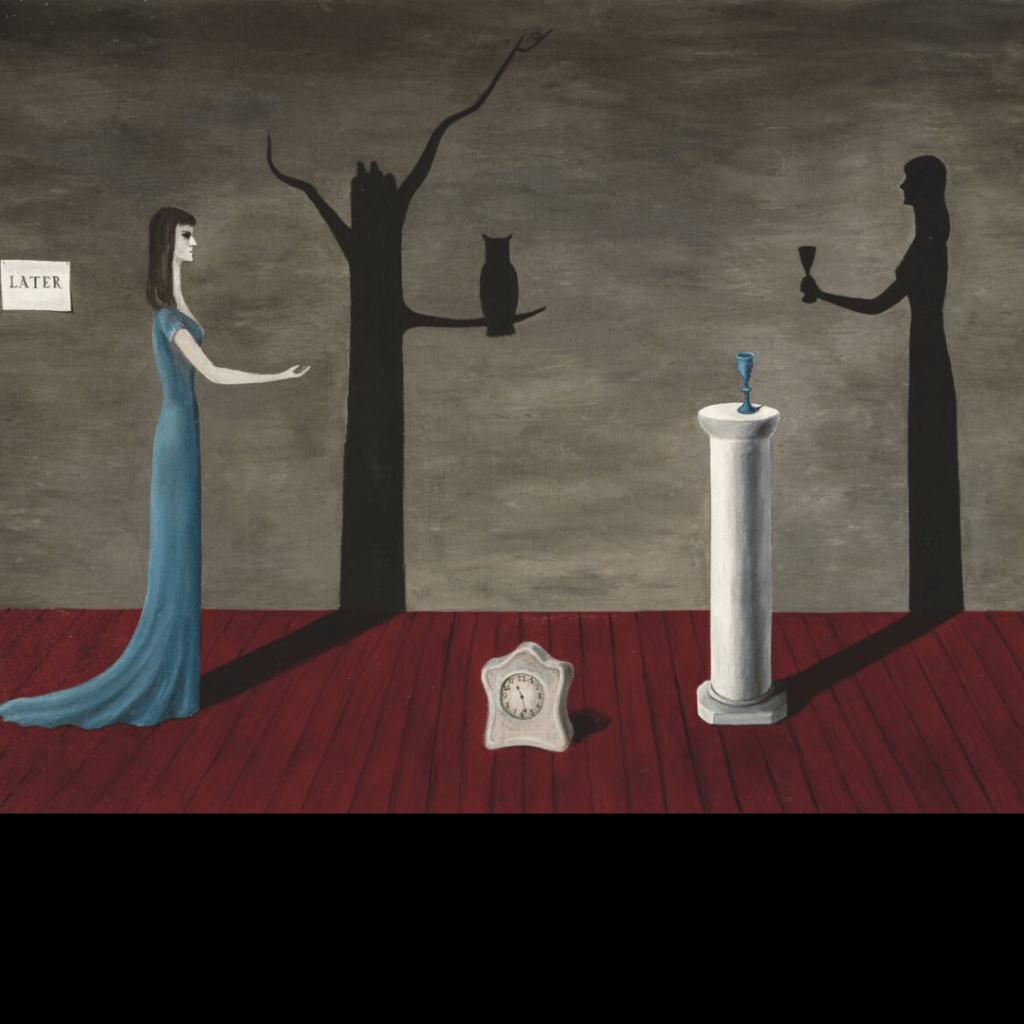
Image: “Strange Shadows (Shadow and Substance)”, 1950
by Gertrude Abercrombie
Image source: New York Dawn

