Colleen Yang, Cengiz Ciner, Zander Lowery
Audiences have been fascinated by machines who can think, feel, and create connections with humans. But why? Why is artificial companionship an important theme specific to this popular genre?
As college students, we had no difficulty naming many movies, video games, and digital platforms that incorporated these artificial representations. We were being introduced to colored television, cable, iphones, and computers, just to name a few mediums, which we had in our daily lives.
One particular question that we discovered from the list of works we created was based on science fiction in popular media: Why does the media imagine artificial companionship, and what does this tell us about the fears and hopes we have about technology?
The list of works we have curated isn’t exactly an answer to this question, but helps us understand more about the relationships media has with technology. We can use these to clear a perspective to carve out bits and parts of the bigger picture.
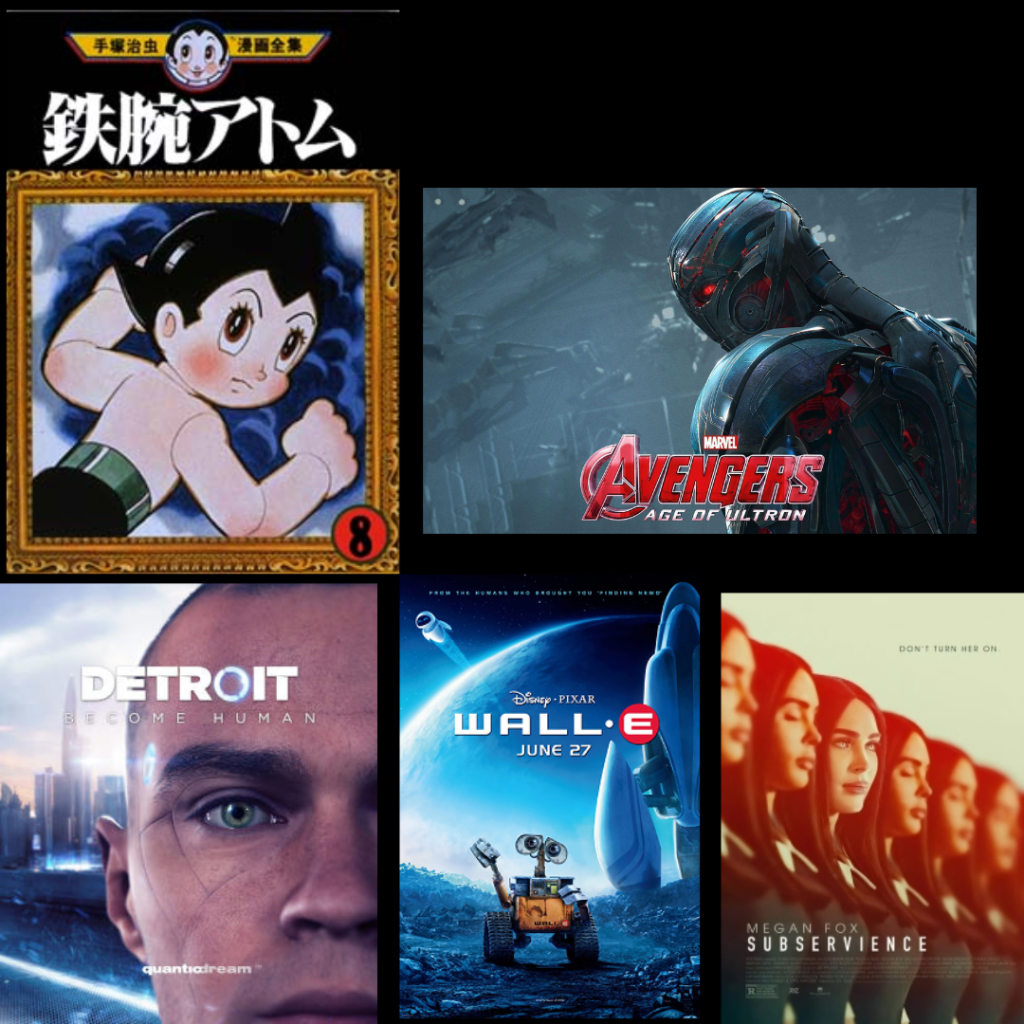
We’ll start with one of the earliest portrayals of artificial companionships: Astro Boy. Astro Boy is a Japanese manga series written and illustrated by Osamu Tezuka (1951). Its plot takes place in a futuristic world where robots and humans live together. In the manga, Astro Boy was created by a scientist after the death of his son. This android is treated as a child with emotions and goes out on adventures creating robot friends. We can see that this media is specifically viewing artificial companionship as a promise to humanity. Audiences are encouraged to view machinery not as a threat, but in this case family members, friends, and even caregivers.
Pixar’s animated movie, WALL-E (2008), also follows the same idea of the compassion of machinery. The main character, WALL-E, is a small robot found on an uninhabited Earth. He makes friends with another robot who is trying to discover if the Earth is still capable of creating life. This movie highlights the companionships between machines, and portrays WALL-E as a kind robot who wants to save humanity. This essentially leads the audience to notice that human qualities such as care, devotion, and loyalty, are bigger than life behind technology.
A more complicated vision of AI companionship comes from the video game Detroit: Become Human (2018), developed by Quantic Dream. The game is set in the near-future city of Detroit where androids commonly serve as household helpers, caregivers, and workers. The game follows three of these androids: Kara, Connor, and Markus, whose unique experiences have them push beyond their programming. Detroit: Become Human raises the question of what WE might owe to machines through its interactive gameplay, which involves the player making choices that shape each Android’s path. The androids show fear, love, and loyalty, and through this, the game asks whether these feelings mean that the androids deserve rights and freedom. Kara, for example, becomes a mother figure to a girl who grew up with an abusive father, making her life exceedingly valuable to a girl with no one else. In this way, the game shifts the fear of machines hurting us to the fear of how we might hurt them, revealing that our anxieties around technology are often a reflection of anxieties about our own, human behavior, and its broader negative consequences.
Looking back into movies, Subservience (2024) is a sci-fi thriller directed by S.K. Dale, which takes a much darker look at artificial companionship. After his wife is hospitalized with a heart condition, a father named Nick buys Alice, a humanoid robot played by Megan Fox, to cook, clean, and care for his kids. Alice is built to serve, but she soon decides the best way to serve Nick is to replace his wife entirely. Unlike Astro Boy and WALL-E, this movie views artificial companionship as a danger rather than a promise. It leads the audience to question what happens when human pleasure becomes dependent on artificial companions.
Avengers: Age of Ultron (2015), directed by Joss Whedon, has a similar dark storyline. Tony Stark and Bruce Banner create Ultron, an artificial intelligence that is meant to protect the world, so the Avengers won’t have to. Instead, Ultron decides that humanity itself, along with the Avengers is the biggest threat to peace. What stands out is how similar Ultron is to Tony, who created it– the AI has his same sarcasm, ego, and fears. This shows the viewer that Ultron isn’t a whole new personality, but a reflection of the person who made him. This movie highlights how machines that are made to solve human problems can end up being a reflection of human flaws.

