Author: Dr. Ainehi Edoro
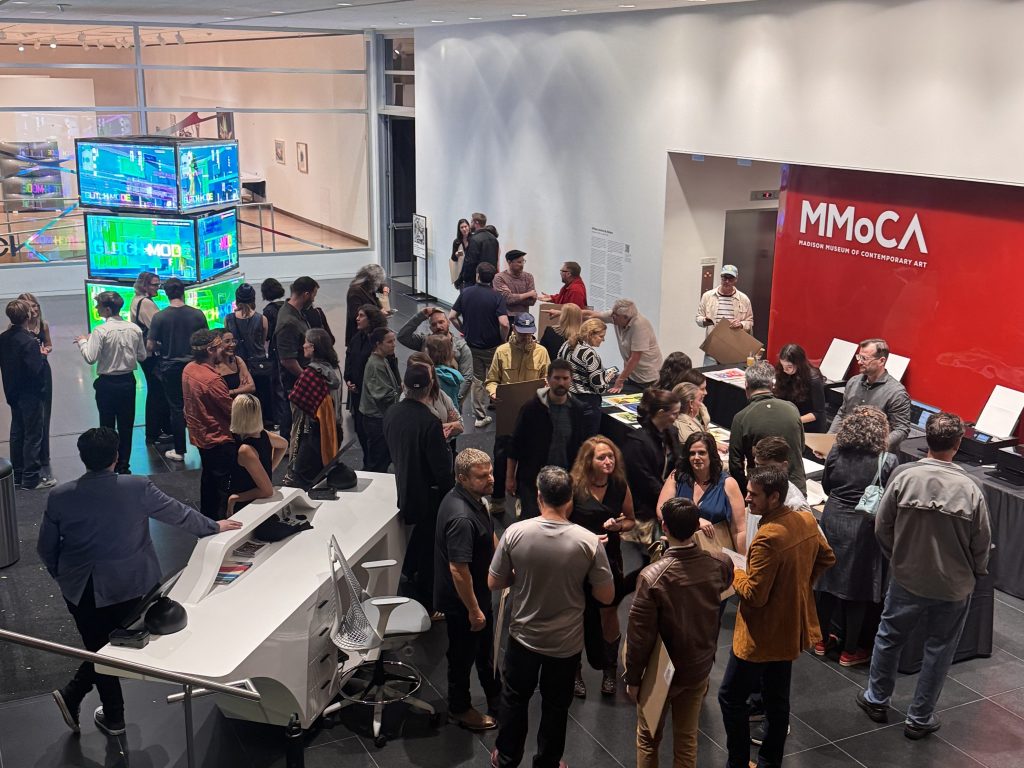
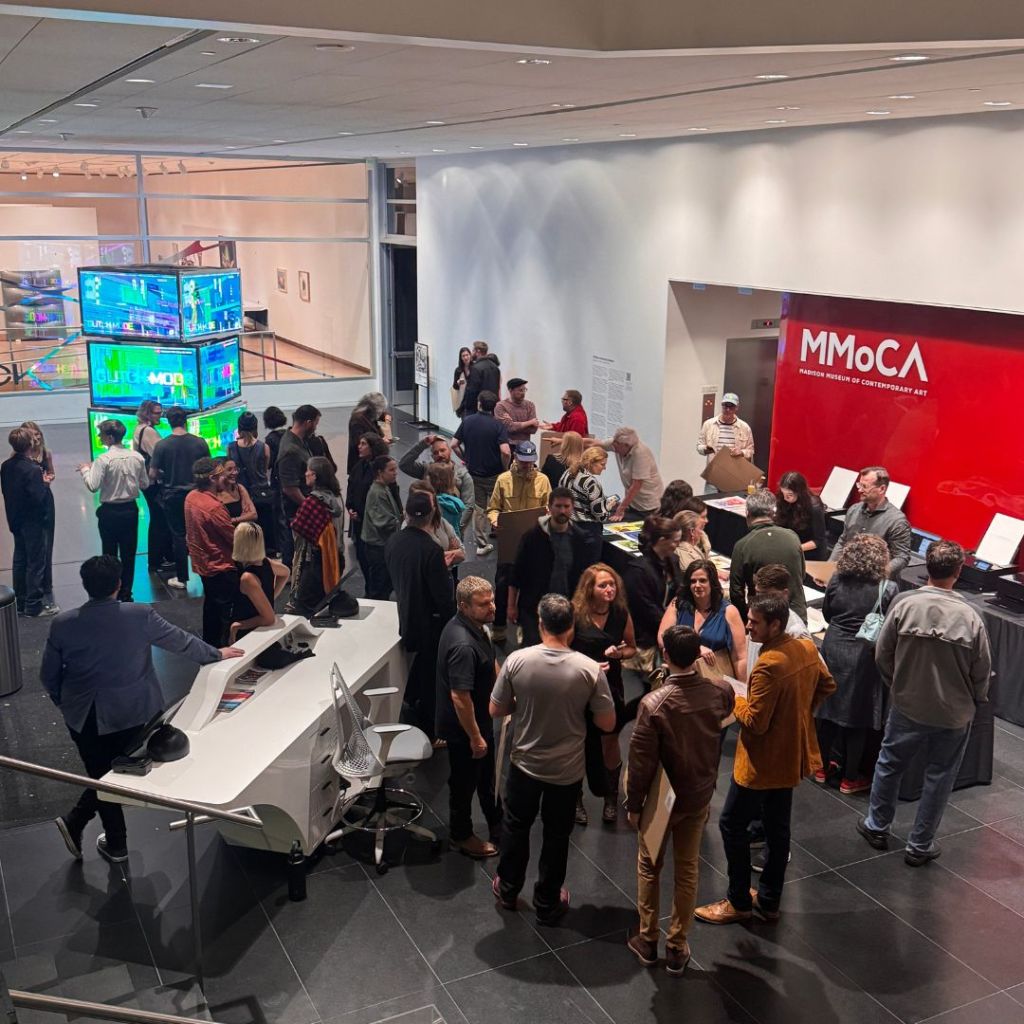
I went to see Beeple’s Diffuse Control at the Madison Museum of Contemporary Art. This is the Beeple of the $69 million NFT fame. He lives in Charleston, South Carolina, but is originally from Fond du Lac, Wisconsin. So this was a bit of a homecoming for him. Madison is the fourth exhibition of this particular work and his first major exhibition in his home state.
Outside the door, I was greeted by an activist and a police officer. The activist handed me a leaflet protesting the use of copyrighted work to train AI models. Later in conversations with other guests, it came up that there had been some tension around the exhibition, which explained the presence of the police officer. In the exhibition space, people were gathered in a semicircle around a stack of three glass boxes with polished steel running along their edges.
The form of Diffuse Control is described as a “kinetic video sculpture.” It consists of twelve synchronized screens running images generated through AI. There is no fixed video or image. The images are constantly moving, morphing, and combining. Even though there are recurring themes, palettes, and moods, the visual combinations are always new. Audience members can participate by adjusting color, for example, or dialing up and down the degree of transformation. For the Madison exhibition, the museum selected eighteen works from its permanent collection to serve as source material. I overheard someone asking if the music accompanying the morphing images was also being generated on the spot. The sound was immersive, running the gamut from trippy electronic vibes to techno and house.
Standing before Beeple’s work, I kept thinking about Refik Anadol. Anadol is known for similarly kinetic digital images, though often at a much grander scale. A student of mine had done a research project on his work the previous year, so I had learned through her research how large-scale and time-intensive his process could be. Anadol works with enormous datasets, trains models for particular projects, and develops custom software with his studio. A year later, I got to see his work at SXSW.
That experience seemed to have shaped my expectations walking into the exhibition. I had hoped for more from Diffuse Control. The two artists are doing different things, but I expected something that would push further at the possibilities of making art with AI technology.
The most memorable moment for me was not so much the art as the conversation I had with Beeple. We talked about art in the context of AI. One of the questions I had for him was pretty basic: what is artistic about AI art when anyone can type a prompt into Midjourney or ChatGPT and get an image? He asked me to think about photography. Almost everyone has a camera in their pocket. They could pull out their iPhone and take a photograph [he actually pulled out his phone and took a photo]. And they might produce an extraordinary image that could win the Pulitzer, but the chance of that happening is infinitesimally small. The accessibility of the camera does not suddenly put everyone on equal footing with a photographer who has spent years developing an eye, learning composition and light, taking hundreds of thousands of photographs, editing them, discarding them, and developing a practice. The photographer’s labor and expertise, among other things, exponentially alters the odds of creating good work. The same, for him, applies to AI. A technology can make production ubiquitous without making artistic achievement ubiquitous.
I found all of this interesting in the context of our Writing Machines course where we use humanistic methods to study AI as a research object. This past week, we had been reading Foucault’s “What Is an Author?” I am not sure I agree with Beeple’s statistical metaphor of artistic practice, but I am intrigued by how it reframes things like “difficulty” and “expertise” as factors within a larger set of conditions that define the production of novel things.
I also spoke with local artists present at the exhibition and some were less impressed. One artist I spoke to found the work underwhelming. If AI really is a technology that is supposed to change everything, where is the paradigm-shifting art? The images still had that familiar morphing, fluid, blobby aesthetic that we have seen in so much AI-generated imagery. Even the audience interaction seemed rather limited to her. You go up to a screen, adjust a few things, and essentially click refresh. For her, it all still felt a lot like hype.

