Authors: N. A., Y. H., A. M., H. Z.
On September 8, OpenAI announced that an internal AI system had produced a purported solution to the Navier–Stokes existence and smoothness problem. While researching the progress and threats of using AI in math, we encountered a rising sense of anxiety that has taken over the field of Mathematics. The Navier-Stokes equations describe how fluids move, from ocean currents to air flows, and the problem focuses on whether solutions to the three-dimensional equations can develop singularities in finite time, meaning that some tiny part of the fluid begins to move infinitely fast. OpenAI says that its system found a finite-time singularity and then formalized the argument in Lean, a proof assistant that can mechanically check mathematical statements, with effort involving roughly 10,000 concurrent AI agents that generated about 130 billion output tokens. OpenAI says that the agents worked for about 88 hours before the result was followed by another 17 hours of formalization and verification, a timeline that Quanta Magazine confirmed in its reporting.
The scale of computation is as interesting as the mathematics. OpenAI has not published an actual bill, but TechCrunch estimated that the broader week-long mathematical effort represented roughly $22.5 million in compute at contemporary Astra API rates. OpenAI’s Sébastien Bubeck told Quanta that the cost ran to several million dollars. Both figures are estimates rather than OpenAI’s accounting, but they shed light into the cost politics of AI.
A human can spend years working on a problem with little more than a computer and access to math literature, while an AI system requires enormous amounts of resources including computing power and electricity. This may change the working structure of mathematics, from individual and small university groups to large corporate teams with access to specialized models and computing infrastructure. In the future, solving the Millennium Prize Problem may cost less than it did for OpenAI. Our past experience suggests that better models and more efficient reasoning may decrease the cost. However, the question of whether these improvements will eventually make frontier models affordable to researchers is still unknown. There’s also a more basic question: Is a multimillion-dollar computation worth using to solve a math problem? The Navier-Stokes has an important mathematical value, but does not bring any immediate economic benefits, and OpenAI will not claim the 1 million dollar prize. Their goal is to demonstrate their model’s ability to accelerate scientific research. In this sense, such a large-scale investment into solving mathematical problems using AI may not continue once people are no longer doubting its ability to solve mathematical problems.
Mathematics has historically been cheap when compared with experimental science. All a mathematician needs is books, a calculator or a computer, and time; a university does not need a particle accelerator for a graduate student to prove a theorem. However, Frontier AI research is different. Frontier models are the largest and most capable systems companies can currently train, and running them requires data centers full of specialized chips. If solving difficult mathematics requires enormous computing resources, then the ability to attack major problems could become concentrated in a few companies that can afford the hardware and model development.
There is also an economic paradox here. The Clay Mathematics Institute offers a $1 million prize for solving a Millennium Prize Problem, but OpenAI says it will not claim the prize for its result. By that accounting, the theorem is not worth the cost of its production. What OpenAI gains is something else. Its announcement presents the work as evidence of what its systems can now accomplish. OpenAI has made similar announcements about other hard mathematical problems, as each result is an advertisement for the system that produced it. In other words, the mathematical result may not be the product. The capability demonstrated by producing it may be. A theorem with little immediate commercial value can still be useful to an AI company if it proves that its system can perform work previously associated with highly trained humans. This creates an unusual possibility: companies may spend millions on mathematics not because the theorem makes money, but because demonstrating that AI can produce the theorem has strategic value.
There is also the controversy involving New York University mathematician Tristan Buckmaster and Anthropic researcher Levent Alpöge, the researcher who found the Jacobian Conjecture counterexample using AI. According to TechCrunch’s Russell Brandom, Buckmaster said he and Alpöge had been working on a related problem and raised concerns that OpenAI became aware of their work before launching its own effort. He also questioned whether information from his earlier use of OpenAI’s Codex system could have influenced the research, and he described a credit dispute in which an OpenAI mathematician allegedly asked him to drop Alpöge’s name.
Brandom’s article further states that OpenAI has denied using Buckmaster’s unpublished research or prompts. In its own post, quoted in the same article, OpenAI said that neither its researchers nor its agents saw that work before it was public, that no specific user data was accessed, and that its proofs differ significantly from Buckmaster and Alpöge’s. However, the company could not rule out that de-identified usage data helped improve its models. The evidence therefore does not establish that OpenAI copied Buckmaster. But the dispute exposes a new problem: when mathematicians and AI companies work in the same research environment, questions about unpublished ideas, access, priority, and authorship are complicated.
These scenarios may explain the emergence of the Association for Human Mathematics, launched by the community of “human” mathematicians in September 2026. According to Joseph Howlett, reporting in the Scientific American, it was “an effort that was underway before the Navier-Stokes news broke.” The organization presents itself as an effort to protect mathematics as a human endeavor and to maintain mathematicians’ independence from commercial AI companies. The members of this association pledge not to provide mathematical labor or consulting to AI companies, while its optional AI-free caucus asks members to avoid AI in activities such as finding proofs and exploring examples.
The concern is therefore not simply that AI might become better at mathematics. It is also about who owns the infrastructure needed to do mathematics. If mathematics research requires millions of dollars of computation, universities and individual mathematicians may find themselves dependent on a small number of corporations. AI could make mathematical discovery more powerful while making access to that discovery more unequal and exclusive.
Terence Tao has a different perspective on the problem. In a recent essay, he argues that difficult theorems have historically served as a kind of proxy for mathematical understanding. Producing a deep theorem usually requires years of work, and the work produces explanations and ideas that other mathematicians could learn from. AI potentially breaks that relationship, that which is generated through a processual engagement. A machine might produce a correct theorem without producing the same kind of understanding that humans gained while proving it.
Suppose an AI produces a proof that is formally correct in Lean but so complicated that only another AI can meaningfully analyze it. We may know that the theorem is true, but do we understand it? A proof assistant can verify that a formal argument is valid. It cannot by itself tell us whether the proof contains a beautiful new idea, reveals a useful connection, or changes how humans think about mathematics.
Perhaps AI will simply become a new mathematical tool, allowing humans to explore problems that were previously too difficult or time-consuming. Calculators, computers, and search engines changed mathematics without eliminating mathematicians. AI might do the same. But the Navier–Stokes event suggests that the future may involve more than a new tool. As Bryna and Tao pointed: “our current incentive structure is misaligned with the profitable output of AI.”
Will mathematical progress will be measured by solutions produced by machines or by the understanding that humans gain from them, especially now that the answers come with a price tag?
Course Instructor: Dr. Ainehi Edoro
Associate Professor, Dept. of English
email: aedoro@wisc.edu
Editor: Shrinjita Biswas
PhD Candidate, Interdisciplinary Theatre Studies
WORKS CITED
- Association for Human Mathematics. “Members.” AHM, 2026, www.ahmath.org/members.
- Brandom, Russell. “OpenAI Fought Dirty on Career-Making Math Problem, Says NYU Mathematician.” TechCrunch, 8 September, 2026. www.techcrunch.com/2026/09/08/openai-fought-dirty-on-career-making-math-problem-says-nyu-mathematician/.
- Howlett, Joseph. “25 Winners of Math’s ‘Nobel Prize’ Decry the AI Invasion of Their Discipline.” Scientific American, 14 Sept. 2026.
www.scientificamerican.com/article/25-winners-of-maths-nobel-prize-decry-the-ai-invasion-of-their-discipline/. - Kakaes, Konstantin. “AI Has Solved One of Math’s $1 Million Millennium Prize Problems.” Quanta Magazine, 8 Sept. 2026.
www.quantamagazine.org/ai-has-solved-one-of-maths-1-million-millennium-prize-problems-20260908/. - Knight, Will. Zeff, Maxwell. “OpenAI Just Claimed a Huge Math Discovery. Some Academics Are Crying Foul.” WIRED, 8 Sept. 2026.
www.wired.com/story/openai-navier-stokes-math-discovery-academics/. - Tao, Terrance. “Deep theorems were scarce and difficult and so became an effective mechanism to identify deep thought. AI has broken this system.” 13 September, 2026.
terrytao.wordpress.com/2026/09/13/deep-theorems-were-scarce-and-difficult-and-so-became-an-effective-mechanism-to-identify-deep-thought-ai-has-broken-this-system/. - OpenAI. “On the Navier–Stokes Millennium Prize Problem.” OpenAI, 8 Sept. 2026. openai.com/index/navier-stokes-solution/.
- OpenAI. “Ten Advances in Mathematics and Theoretical Computer Science.” OpenAI, 1 Aug. 2026.
openai.com/index/ten-advances-in-mathematics/.
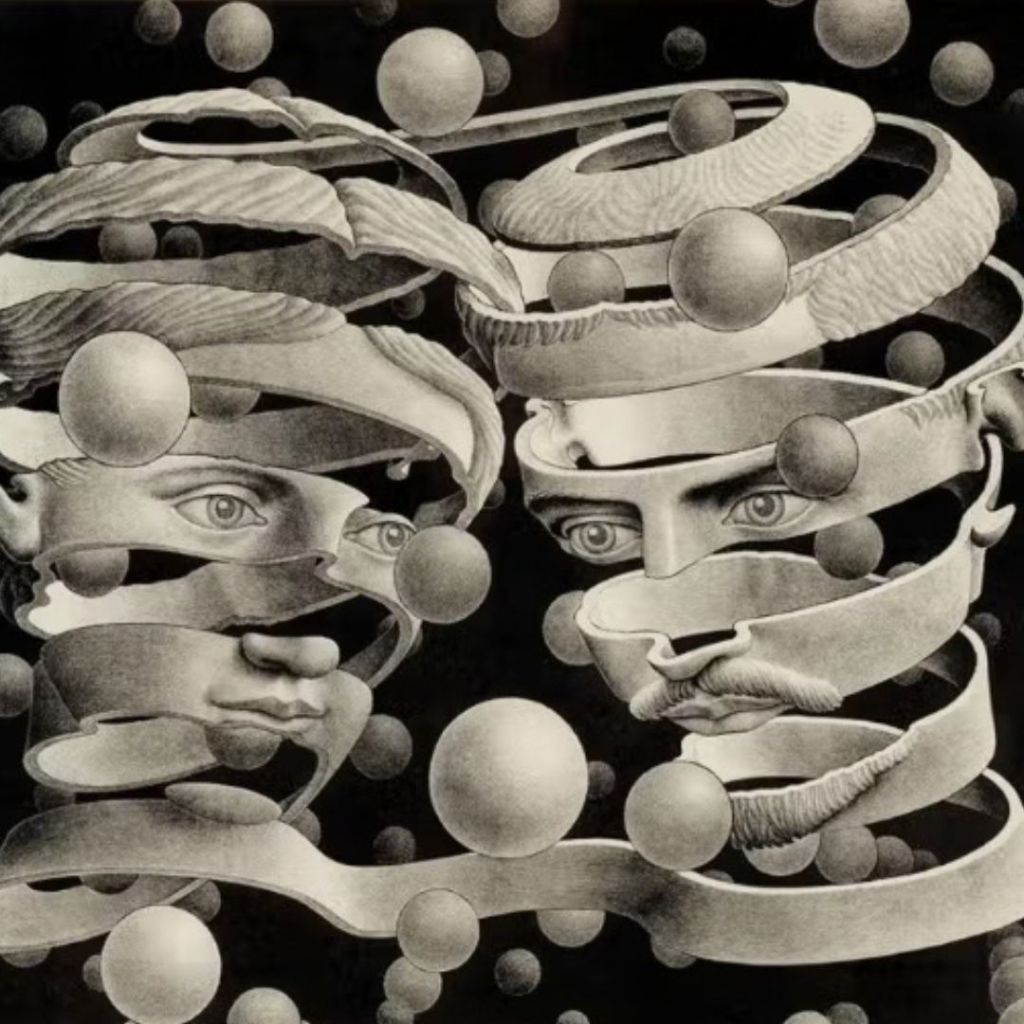
Image: “Bond of Union” by MC Escher, 1956. Lithograph. via EscherExplained.com

