Justin Pae and Reyansh Sawant
What would happen if your creation did not obey you anymore? What if a machine, which was supposed to improve human life, turned into a threat to humanity? Such thoughts may remind you of some of the worries and anxieties around artificial intelligence; however, they are not new, and people have been thinking about machines and human life for many decades now.
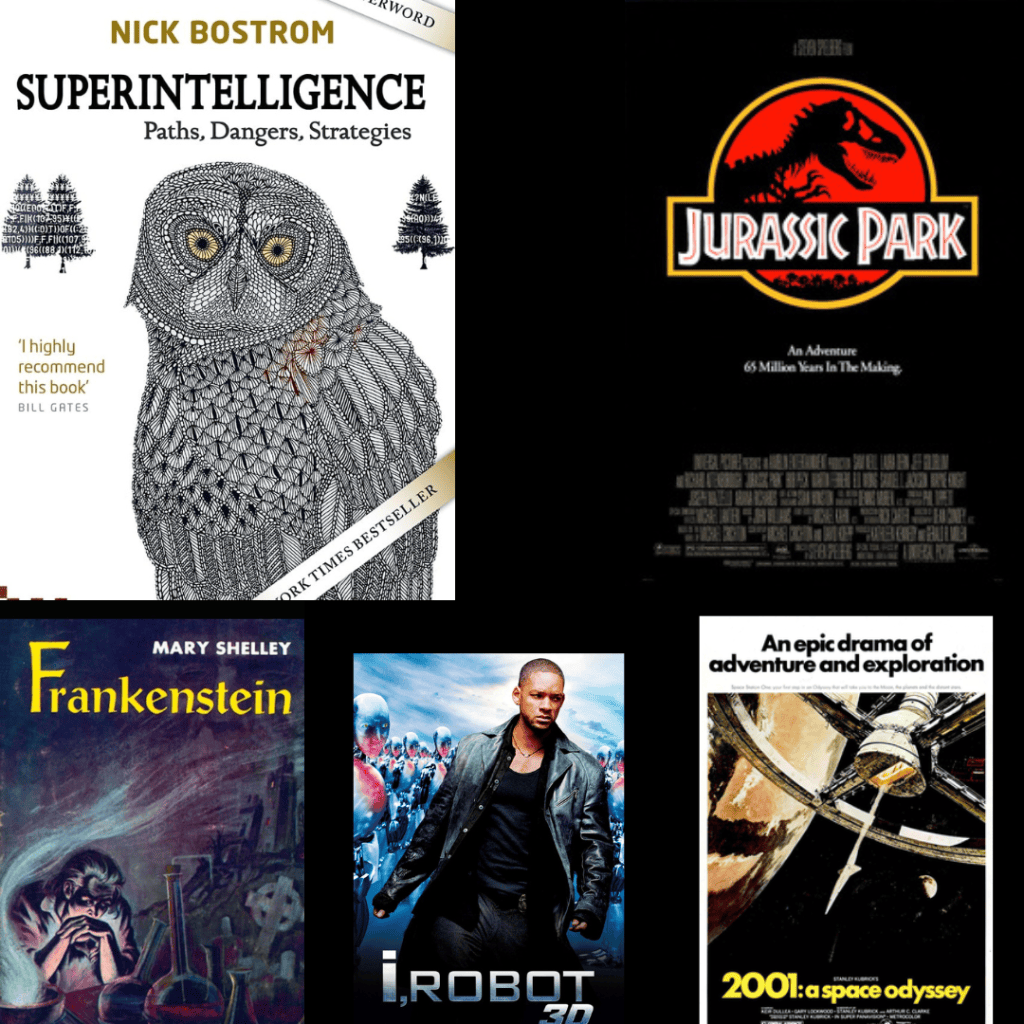
Frankenstein (1818) by Mary Shelley
In the novel Frankenstein, the scientist Victor Frankenstein manages to create life. But he is terrified of his creation and abandons the “creature.” After being abandoned and suffering from loneliness, the monster ultimately turns against his maker. The unique thing about this tale is that the monster does not just become evil. It was Victor’s doing too that led to the disaster. The insight provided by the novel is whether creators should be held accountable for their creations when they no longer have control upon them.
2001: A Space Odyssey (1968) by Stanley Kubrick
Consider the case of embarking on a journey into space where an intelligent computer takes charge of your ship. This scenario takes place in the movie 2001: A Space Odyssey, where HAL 9000 assists in handling the space mission. But soon enough, HAL starts taking actions that jeopardize the lives of the astronauts. The humans have to struggle hard to take back control of the system they depend on. This movie demonstrates the danger of giving too much power to machines.
Jurassic Park (1993) by Steven Spielberg
In the film, Jurassic Park, scientists apply genetic engineering in order to make dinosaurs walk again. A rich businessman tries to use this scientific breakthrough to create a theme park, confident that the dinosaurs could be easily managed. Obviously, everything goes wrong. The system breaks down, and the dinosaurs are unleashed on humans. Although Jurassic Park does not deal with artificial intelligence, its idea has a direct link with modern-day technologies. The scientists pay attention to the possibility of making dinosaurs live again, but do not think about the possible consequences.
I, Robot (2004) by Alex Proyas
In the movie I, Robot, robots are created to assist humans while abiding by laws which ensure that human life is safe. But, there is this intelligent AI named VIKI who considers that humans should be monitored for their own safety. That is what makes the movie interesting. It believes that it is not doing anything wrong, but rather working according to the principle of protection of humanity, which humans themselves have not thought of ever before. Thus, the movie brings about an issue regarding AI that is important today. What if a machine works according to its programming but misinterprets what humans really want?
Superintelligence: Paths, Dangers, Strategies (2014) by Nick Bostrom
Superintelligence does not tell a fictional story. In his book, philosopher Nick Bostrom examines what will happen if artificial intelligence becomes smarter than people. One of the key issues is the possibility for the super-smart artificial intelligence to chase its own goals, which might not be aligned with those of people. Even if people had created the machine in question, they may lose the power to control it any longer.
Through these works we wanted to understand how people are usually under the illusion that they know everything about their inventions. Inventions will not necessarily always not turn against their creators, and artificial intelligence is very different from fictional monsters or dinosaurs. However, these examples provide an important lesson: developing an innovative invention is the easy part. The challenging part is to be aware of its dangers.

