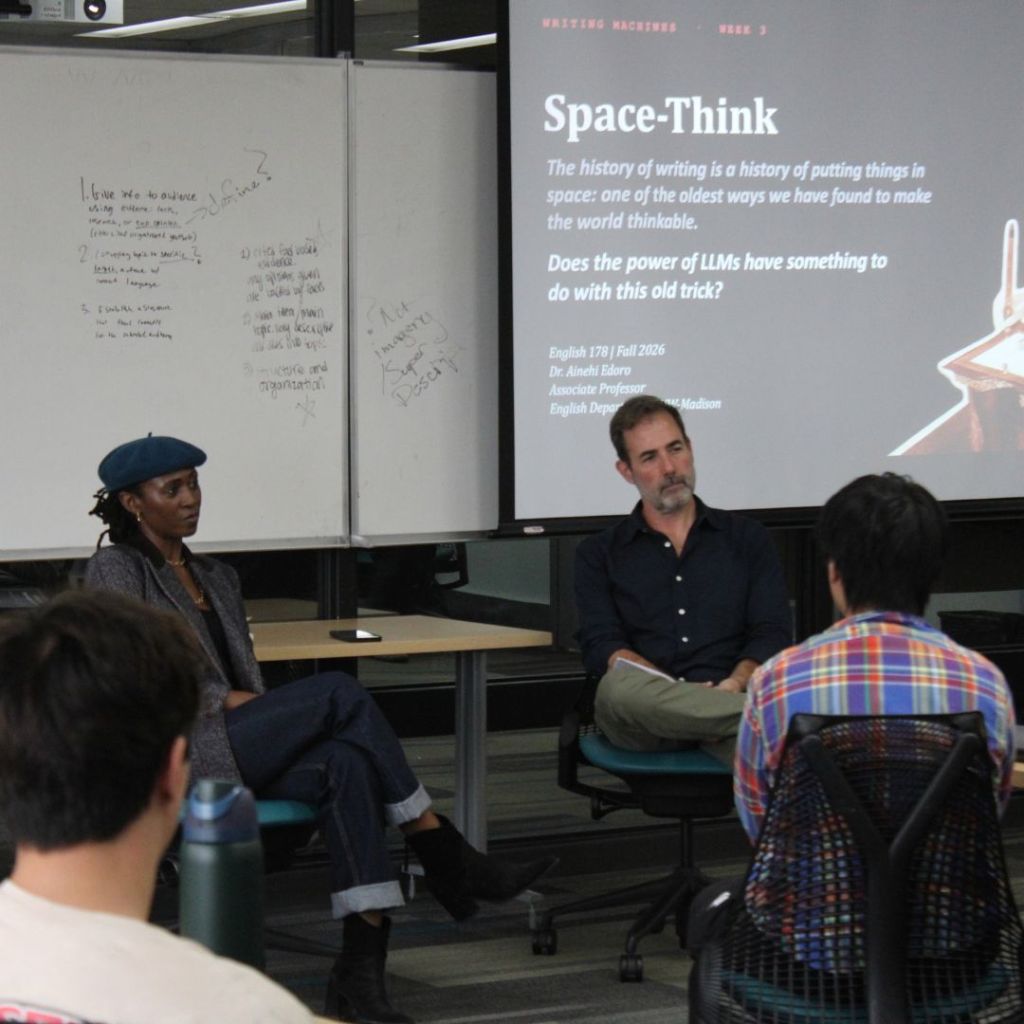
On September 30, the Writing Machines course hosted Tarleton Gillespie, former Senior Principal Researcher at Microsoft Research. We discussed AI, social media, the history of the web, and the language of intelligence, with particular attention to the continuities between AI and earlier information systems.
The conversation, in some sense, anticipates Gillespie’s public lecture later that day at the Digital Hub, where he made the case for approaching AI through its deeper histories of media and technology.
Ainehi Edoro:
This week, we’re looking at Alan Turing’s 1950 essay, where he poses the question, “Can machines think?” We’re using it as a jumping-off point for thinking about intelligence as a particular framework for talking about AI, large language models, and related technologies.
So maybe we can start there. Can you help us think through why intelligence, as a term, has such enormous purchase in how we understand or make sense of AI today?
Tarleton Gillespie:
Thanks for the chance to be here. I have two reactions to that question. One is that I always want to answer with empiricism and history. There’s a reason why a term like intelligence comes into play and why people gathered around the concept. A term like intelligence has landed so firmly in a set of technologies that are only defined by intelligence if you continue to have a conversation saying they’re about intelligence. It’s a circular effect. They’re there for very particular historical reasons. People who thought they were doing something landed on that set of ideas. That set of ideas seemed to resonate with people and justified investment and interest in other fields, and became a kind of gathering point.
A lot of times, these terms, the ones that are really vital, the ones that stick and become widely known ways to understand something that’s complex, are there both because someone put them there and they stuck. And I think that both of those things have to be true.
Jennifer Light’s work, “When Computers Were Women,” is really interesting: the women who calculated the numbers you needed to send ballistics to a target were called computers, and then they got replaced by devices. These terms are always kind of tangling with the humans that do things and the thing that could do what humans do.
The other side of the question is that a term has to resonate, right? Not just among a handful of people who find it useful, but for it to carry into something like artificial intelligence, where we’re all talking about it. The resonance has to be deep and cultural, not universal, but deep in a culture. The way these technologies test our understanding of ourselves and what we think intelligence is, the way that when they do things that are marvelous, they feel smart, or they enact something that we thought only humans could have. We have this reaction when, like, a crow breaks a clam and we’re suddenly like, “Oh my God, that was strategy.” And so animals can test our edges of intelligence, and machines can test our edges of intelligence.
The last thing I would say is, as I was seeing people inside Microsoft and in the industry making advances in LLMs, I was surprised how often they didn’t have a definition of intelligence. It wasn’t, as you might imagine, “Okay, what’s intelligence? Now, can we make a machine do it?” It was, “Can we make a machine do a thing? How do we call that intelligence?”
I was fascinated by how, at the last minute, they would demonstrate, “Here’s what our GPT can do. We’re going to run it through 93 benchmarks.” Then the first page would be like, “Human intelligence is…” and they would grab some definition from the ’90s. But then you’re like, “Oh, that was just a paper you found and then used that as your metric.”
But what they needed was a tool that could do things on a metric, and then the intelligence kind of came late. Which is very different from imagining someone’s going, “Yeah, we make intelligence.” I don’t think intelligence drove it as a concept.
Ainehi Edoro:
Right. That’s quite different from how it’s imagined in the public sphere, where we tend to think of these as people making intelligent machines, rather than intelligence as a way of making the technology legible.
Tarleton Gillespie:
Public legibility is always tangled with money. And not to make it crass, like, how do you sell a technology? It’s not as simple as that. But how you sell it in a broader sense, how you make it legible, how you convince people it’s worth something. And then how you get them to pay for it.
To say, “We figured out how to put a bag of words together so that if you ask a question, some combination of words that might be useful will come out of the computer,” doesn’t sell a product, doesn’t sell a cultural investment. But to say, “This thing will understand you and will do what you want and will come up with new ideas,” is a powerful offer, even when it doesn’t meet that.
Ainehi Edoro:
Good point. What you are describing is particularly clear with technologies that have not had the same luck. I’m part of a quantum theory working group for the social sciences and humanities, and one of the things we’ve been thinking about is that quantum has struggled to find its equivalent of what intelligence has done for AI, a concept that makes the technology legible and allows it to gather broader interest.
But the other question I have for you concerns a certain kind of critique of AI. People will say, “AI is just glorified autocomplete.” It’s the kind of critique that dumbs down the technology and tries to say, “It is just this.” And even if you sympathize with the critique, you’re like, “Not really.” There is something, let’s say, “marvelous” about how the technology works and what it can do. I don’t mean marvelous in the sense of good or desirable, but in the sense of encountering a marvel, a spectacle, like watching a magic trick and wondering, “How did it do that?”
So if you don’t call what AI does intelligence, how have you personally tried to understand what is special about it? I want to stay with “marvelous” in that very limited sense. How have you tried to articulate for yourself what is “marvelous” about this technology?
Tarleton Gillespie:
Okay, that’s a great question. I think about public discourse, like, what’s my job in public discourse? And I’m often on the side of trying to diminish the claims because the work being done to tell us how marvelous the technology is can be very loud, right?
We are swamped with hyperbole and advertising and explanations saying that this thing is sentient and is going to transform everything. So the critic in me often wants to say, “Hold on. What’s the work that all that storytelling is doing? What is that offering?”
But you’re right. To say, “Sorry, it’s just this minimal thing,” and dismiss it isn’t the move either. Part of my answer is that every technical accomplishment that is marvelous was, at its base, something not that complex. The ability to put two not-complex things together at the right moment can produce something quite dramatic. If you played with GPT-2, it was garbage, right? It was terrible. But that doesn’t mean that there wasn’t something quite special about it generations later.
If we want to be historians of technology, we have to be able to say that an innovation can be tremendous and that the hyperbole around it can be overblown and purposeful. Something as simple as levers and pulleys can add up to something quite sophisticated and profound. Those things can all be true at the same time.
This comes back to the intelligence question. The thing that many AI designers don’t understand–when they talk about intelligence, and then are blown away when this piece of software can spit out sophisticated paragraphs and can break down tasks and can, you know, write poetry–is that their theory of intelligence locates it in the individual brain. They’re like, brains can do things. Brains can explain arguments. Brains can write stories. And now this thing can do what brains could do.
To me, the hidden, or missing, piece, and this is a media theory thing, is that the entire web is a piece of intelligence. It’s massive. It’s collective. It took an immense amount of contribution. It’s full of garbage, too, but as a composite, it’s a bit like a map. When you open a map and try to navigate down the highway, that map is the product of thousands of people who traversed land, came up with calculations, and developed ways to represent them on a piece of paper. So you can go, “Oh, take a left, go eight miles, and then there’s a hill.” That thing is marvelous, but the intelligence behind it has sort of gone missing. You don’t know about it. You just interact with the tool and say, “Wow, it gets me there. It’s amazing,” almost to the point that you forget how amazing it is.
The same is true of the web, the history of published books, every scraped transcript of a YouTube video. If you have a theory of collective intelligence or cultural intelligence, that was already intelligence. To be able to query that mass is like going to an encyclopedia or a library and thinking, “I can get an answer to anything.” It’s because intelligence was held in that thing.
When they scraped all that data and then turned it into something that could spit out answers, they forgot that they were just riding the intelligence of something we took 30 years to produce, or much longer, depending on what you include. And that’s the piece that is marvelous.
Ainehi Edoro:
I really like that. Where you locate the intelligence can determine how you understand the true scale of a technology.
Tarleton Gillespie:
The source of the marvel, to me, is this accumulated human intelligence that we produced without even really thinking about it. We all posted our stuff. News organizations and other organizations put their material online. And then we collected an imperfect, but very rich piece of intelligence.
Ainehi Edoro:
Thinking about the web and its history in relation to the broader history of digital technology, I don’t even know where to start. We now have these fairy tales, I call them fairy tales, where we start with Leibniz. And then we tell this story: Leibniz, George Boole, Ada Lovelace and Charles Babbage, and then Turing. These stories where you’re just like, it’s too simple, right?
What is your own story about how we’ve come to AI? If we start with the web as a technology, then move to social media, which you’ve written a lot about, and then to AI, how would you line those pieces up? How have these technological environments intersected?
Tarleton Gillespie:
One thing I’m struck by is that as I watch the people who are developing and writing about AI, they don’t think of it as a lineage. They don’t spend a lot of time thinking about the parallels to social media, which, to me, is the last enormous example of what happens when you make a semi-automated information system that is global and public and immediately has impact, and is promising to be for everything, and is both marvelous and terrible at the same time.
That lack of a lineage has something to do with the way disciplines work. I think there are people who train in AI, and their lineage is AI: Can you make an intelligent machine? And there are other people working on recommendation algorithms and information retrieval who come out of different technical traditions.
But I think that for users and for the public debate, the connections between these technologies are more apparent because we’ve lived through these cycles. Whatever age you are, you know that there was the web, and then there were search engines, and there was social media, and then there was artificial intelligence.
And already, there’s kind of a funny gap. To me, the web and social media are distribution systems, and the idea was that their content comes from people. But what we can do is collect it, connect it, help you find it, recommend it—all the innovations that we’ve seen in search and social media recommendation.
Again, for good and for ill, everyone will put stuff on there for all sorts of reasons: creative ones, financial ones, angry ones, happy ones, doesn’t matter. But then all that stuff becomes this available resource. Experiencing it through Facebook or TikTok or Instagram or through a search engine, has its own effects, this kind of collectivity, for positive or negative.
AI is a production tool. We’re bumping into its products online. We can see AI slop on Instagram, but it’s also this thing that you log on and have it do things. That dynamic is different, too. But new information systems don’t come out of nowhere, and generally AI, as we’re experiencing it, isn’t exactly a product of the AI industry. The idea of what we do with a massive information system that is also intimate—I sit down, there’s an app, and I type something into it, while knowing there’s this massive system behind it that is relatively invisible to us—how we grapple with that was already informed by how we’ve had to think about social media and search.
P. T. (Student)
Your point earlier was that a major part of what’s happened in recent years is figuring out how to package AI and sell it as a product. But they seem to be selling more than just a product now. The CME Group, in I think five days, is going to launch compute futures contracts based on Nvidia H100 rental prices and B200 GPU rental prices.
I’m curious what you make of compute as an asset class, and then what would intelligence as an asset class look like? Token futures? What would that consist of? And what effect do you think that has on AI companies and AI research and development?
Tarleton Gillespie:
Interesting. The sociologist in me always wants to avoid prediction, because these things are always more complicated than what you’d ever imagined. Some of us will guess and get it right, but that’s not because we knew anything. It’s just statistical. But I do think that, as researchers, we can say, what if? We can say, here’s a possible future and think through it, or here’s the future that someone is aspiring to. So that’s my caveat for that question.
I think the compute question is really interesting because AI companies have found themselves, “caught” is the wrong word, but beholden to the hardware. There’s the rapidly growing expense of what it takes to train a new model as well as field queries, and consumer-side AI blew up faster than even some of the practitioners were expecting.
This has put the question of hardware—literally hardware in boxes and giant buildings—in a really interesting position. This frictionless intelligence that we’re all supposed to be able to tap into has a real material ground. It’s also put the people who make chips and high-end computing, and the geopolitics of where those things come from, right at the center of the growth of AI companies.
The politics of data centers is one version of that, which I don’t think is just about people not wanting big buildings that draw electricity. It’s also: “what’s the bill of sale of general AI? Did I ever really want it? If what you’re telling me is the cost of this big building, but I don’t even see the benefits, then I have additional problems.” It’s a way to articulate a kind of ambivalence and frustration.
I don’t know how to think about what the future of this looks like, how we’ll encounter and pay for the use of AI. If we take the lessons of social media as an indicator, it took them a decade and a half to figure out what their business model was. So if we say that AI is on a faster but similar curve, what we’re seeing now as experiments may or may not be the way they figure out how to do it. Are you paying for tokens? Are you paying with your advertising? Are you paying with your data? Is the hardware industry paying? Is the output paid? There are a lot of ways that information systems, media, social media, search, generative AI, have to pay for the service they’re providing.
I see three models that are not predictions, but that people are building toward, so let’s think them through. One is the big GPT that is going to answer everything and is stuck everywhere. Another is the agent swarm world. I know there was a lot of excitement at Microsoft about agents. Maybe the thing that we’re not ready to grapple with from a societal point of view is not the oligopoly thing we’ve dealt with before, “here’s three big companies, and they own the resources,” but the mad scramble of: what if the easy thing is that you can hire 30 agents for half an hour to do a task? You get the chaos of relatively unregulated, smaller tools that are built upon that intelligence but are acting, going onto the market, going onto the web, or going into other computer systems.But then it’s hard to guess what the financial part of it is, because if you’re paying for how many times can I hit ChatGPT, that’s one thing. If you’re paying for how many agents can I run as a squad to do a task, that’s another thing.
And then the third one that I really think a lot about is AI companions. The media scholar in me is like, that’s the part we’re not seeing coming. When we ask, “How are these big companies going to sell these big tools?” The answer: “Oh, it makes your Google search better,” or “It makes your Microsoft Office better” doesn’t quite work. That doesn’t pay the bills. But if people are chatting with these things and they’re getting emotional, socio-emotional value out of them, and someone says, “You can pay $3.99 a month and have a boyfriend,” that’s a market.
So those are three: the big GPT that’s going to answer everything and is stuck everywhere, the agent swarm world, and then the companion world. This is not a prediction, but they’re taking form, and people are building toward them.
A. M. (Student)
I guess the pressing question we’ve been seeing in the tech space— I’m a computer science and data science major, but generally I’ve been wondering about this. Companies are saying that within the next five to seven years we could potentially reach AGI. I think that’s a little too optimistic about how far AI can go.
But I’m wondering about the current landscape. These companies are basically scaling now, trying to consume as much information as possible for these models. Is that actually the right way to get to AGI? Or would it require more of a recursive learning pattern, where models have to learn through experience, more like humans do as we interact with things day to day?
Tarleton Gillespie:
There’s a lot in that question. Because you raised and threw doubt on the idea of general intelligence, but then you were like, how do we get there?
Like we started with, intelligence is a moving goalpost. We think through the idea of intelligence with our own tools. We always have. If we think about writing, print, television, photography, social media.
So I think we will hit general intelligence when the industry wants to say, “Look, we did it,” and the version it points to will be, in some ways, smarter than anything we had before. But it won’t be intelligence, but it will be intelligence, and then we’ll rethink intelligence in relation to that. If the definition can move and the technology can move, then at some point you can say, “Oh, it’s achieved it.” You redefine the goalposts and say, “Well, intelligence is if it can solve every LSAT problem or if it’s recursively building itself, then it’s intelligence.”
But there’s a different question: what are the implications of this ravenous training on as much data as possible, whether or not you think that what it gets to is general intelligence in some conceptual sense, or if it’s just a more sophisticated GPT? The field is certainly debating what happens if more and more web content is AI-generated. You get a bit of a snake feeding its own tail, the synthetic data problem, and there are people really worried about that. So we’re living in an environment where finding new data that your competitors don’t have is an incredibly lucrative and sometimes problematic activity. And it’s now a big part of how AI companies are running their business.
A. M. (Student)
I guess eventually it comes to a point where AI models know so much information that no human could process it within a lifetime. The general consensus might become that we’ve reached that AGI point, even though we may not necessarily have, because, as you’re saying, the definition changes every time.
Tarleton Gillespie:
What you just did in that sentence is exactly what we’ll do. You said, “Is that intelligent?” and then you gave it a proxy. The proxy was: What if they can know more than we could ever know? Is that intelligence?
The library knows more than we can ever know. So is it intelligent or is it not? That’s why I want to test that concept. We have, for a very long time, lived amidst systems that provide knowledge and provide answers and responses that come from an array of places. I’m talking vaguely in order to include things like search, but also an encyclopedia. How those things come together, how they are valued, and where they come from changes. But our understanding of what it is we’re trying to achieve, and then what it is that we have that is special beyond that, has to shift along with this.
That’s why I like the longer-term view of this as media and information. This has always been a media and information question, as early as writing, and it continues through every one of those innovations. There is something different, but I think the continuity or the echo is really important.
Ainehi Edoro:
The AI space can be overwhelming, especially for people who are trying to get oriented. The news cycle is intense, and the technology itself can be difficult to understand. If somebody wanted to get grounded in the technology and the larger questions around it, where would you tell them to start? What book might they read?
Tarleton Gillespie:
Yeah, it is bewildering right now. But getting a handle on it depends on what you’re trying to get a handle on: whether you want to understand the technology, the public problem, or the industry.
The book that popped into my mind when you asked is by a scholar named Mona Sloane. It’s called Predicted and came out this year.
One of the things I really like about what she does—and it’s a very readable and teachable book—is that we tend to think that every time a technology shows up, all bets are off. New questions, everything’s new. What she does is draw the lineage.
There were lots of scholars thinking about AI when AI was machine learning, about the algorithmic ethics of systems that dole out search results or job listings, and the problem of automating judgment. That work wasn’t based on foundation models. It was based on machine learning technology.
And that literature has had this weird sort of interruption, because now it’s like, “Oh, GenAI is different, so we have to think all differently.” But lots of the questions persist. She’s got a very clear sense of: here’s the technology, here’s the industry, here are the key public concerns from a sociotechnical point of view, which is the perspective I’m taking.
The other one that I was quite impressed by is Karen Hao’s Empire of AI. If you want to understand the industry, there’s a ton of books that come from journalists, and they talk about the industry. Lots of them are kind of like, “And Sam Altman did this, and then they did this,” very sort of gossipy. And there’s some of that in there, but she was awfully good at having these chapters that stepped back and understood how the investment into this came to be and how the worldviews came to dominate. I was really impressed by that one compared to some of the similar ones.
Ainehi Edoro:
The colonialism conceit at the center of the book is also helpful because it makes you see AI tech as a question of power and resources, but also as a geopolitical question. It grapples with the problem at different scales as well, from rare earth minerals to the worldviews driving the industry.
Tarleton Gillespie:
Right, and written with a journalist’s ability to get at the heart of things, but not get lost in thickness.
Ainehi Edoro:
Thank you so much for coming. We really appreciate it.
Students:
Thank you.
Tarleton Gillespie:
My pleasure. Thank you. Thanks so much.
***********
Image by Shrinjita Biswas

