As a literary scholar, I’m guessing it’s not that surprising that I have never really found mathematics interesting. Math always seems to me too far removed from reality, the way it reduces everything to systems and structures.
Literature I love. Yes, storytelling is a form of abstraction, but it is an abstraction that is tethered to life. Stories use language to make us feel things. Math, is what you get after squeezing all of that sensation out of life.
But, in all honesty, I’ve been increasingly suspicious of this binary, ever since my journey into AI.
The more time I spend reading engineering papers the harder it is to hold the division between numbers and stories. Engineers may work with numbers, but insofar as their systems are trying to interact with reality, there is a surprising amount of world-building embedded in them. I am intrigued by the lives and stories and assumptions about the worlds hidden in mathematical theorems and models.
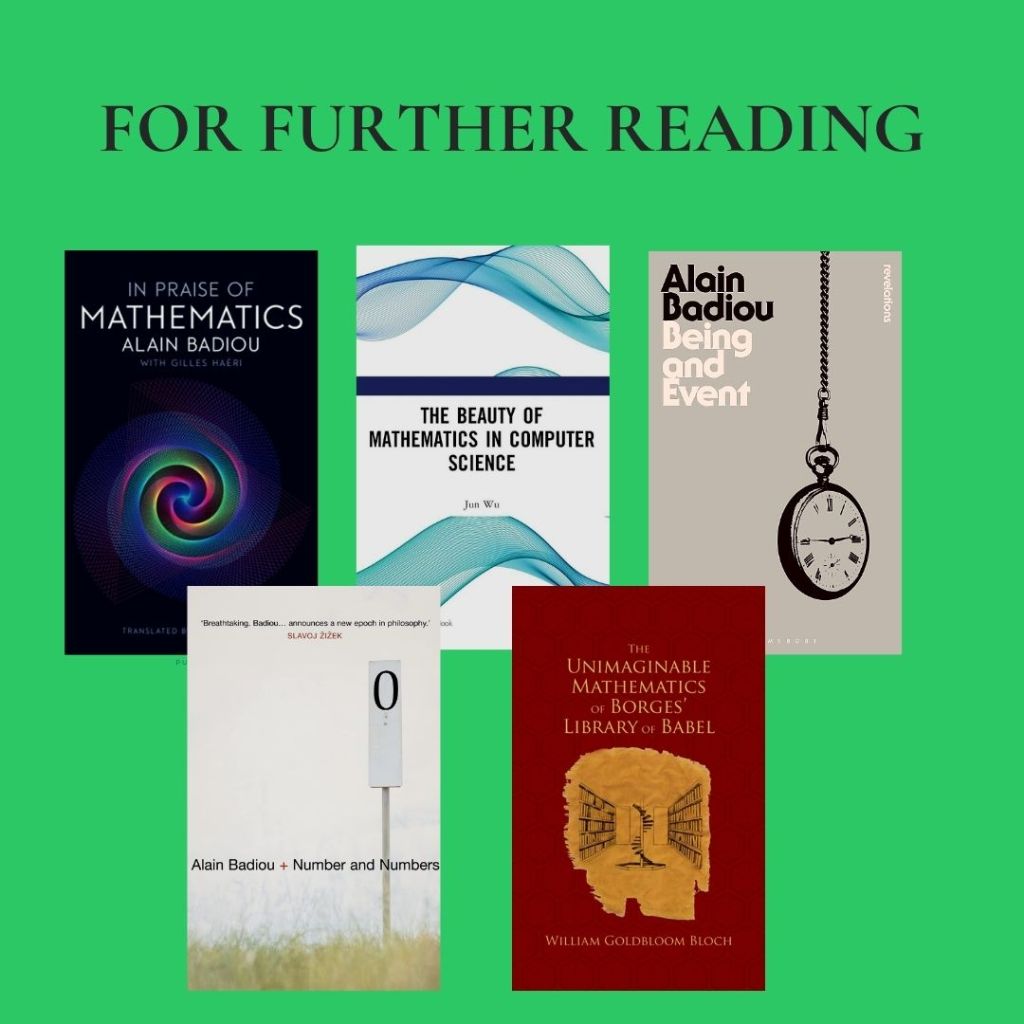
This has made me curious about thinkers who straddle mathematics and the humanities. Apparently, there is a whole tradition of philosophers, literary critics, and cultural thinkers who take mathematics seriously as a way of thinking. So, for anyone coming from literature who is similarly curious about mathematics but perhaps a little intimidated (or bored) by it, here are a few books that have helped me.
Alain Badiou has been especially important for me. He is a French philosopher and (hopelessly) in love with mathematics. He believes that mathematics can give us access to certain kinds of philosophical truths. His major work, Being and Event, was published in 1988 and the English translation in 2005. In the book, he uses set theory to think about belonging and exclusion, formal structures, history, politics, and revolutionary change. It is a notoriously difficult book but worth the hassle. I should mention Number and Numbers (1990), but I found it too narrow of a focus on a certain kind of genealogy of math and philosophy. The one line I did love from the book is when he refers to the obsession with metrics in the tech world as “the unthinking nepotism of numbers!”
For a much easier entry into Badiou’s mathematical thinking, I would recommend In Praise of Mathematics (2016). It is a petite book that features an interview in which he addresses the relationship between mathematics and philosophy. It is a gorgeous book that reads like a love letter to mathematics, though addressed to humanists, to convince them that math is a language that we all should learn how to speak.
There is also this wonderful book titled The Unimaginable Mathematics of Borges’ Library of Babel (2008) by mathematics professor William Goldbloom Bloch. Borges’ short story, which we will be reading in this course, is about a library that contains a universe-size number of books. Bloch takes Borges’s tiny, weird story as a mathematical object and builds an elaborate series of mathematical questions about space, infinity, combinatorics, probability, and the limits of knowledge.
I have also really liked The Beauty of Mathematics in Computer Science by former Google research scientist Jun Wu. The book was originally written in Chinese. Wu flits effortlessly between mathematics, technology, history, and everyday life in a way that I find beguiling. A friend of mine recommended it, and I loved it. It is a break from the typical tech-bro/tech-utopianism writing. He shows how mathematics answers lots of the questions we have about the rise of a digital technology.
I don’t know that I will ever warm up to mathematics, or ever stop being suspicious of its reduction of experience to abstractions. But I like that I am getting more curious about the strange ties between mathematics, logic, and, as we are going to explore in this course, writing.

